

Selecting the most cost-effective metal finish for corrosion protection1 requires balancing initial cost, service life, maintenance requirements, and specific application environment – for most industrial applications, zinc-nickel plating2 and trivalent chromate typically offer the best value combination, providing 10+ years of protection at 30-50% of the cost of premium solutions. Through analyzing performance data3 and lifecycle costs across various environments, we can identify which treatment delivers the optimal return on investment for specific applications.
The most cost-effective corrosion protection solution isn’t about finding the "cheapest" or "most durable" option, but rather identifying the optimal balance between protective lifespan and cost – requiring consideration of multiple factors including material exposure environment, expected service life, aesthetic requirements4, and maintenance capabilities. The value sweet spot varies significantly by application scenario, with no one-size-fits-all solution.
Cost vs Performance Comparison of Metal Finishes
Evaluating metal finish value requires assessment across three dimensions: protective performance, service life, and total cost – where zinc-nickel plating excels in harsh industrial environments, trivalent chromate5 proves most economical for indoor to moderate corrosion environments, and electroless nickel delivers superior value where high wear resistance6 combines with corrosion protection needs. Different processes show significant variations in both cost and lifespan.
| Finish Type | Initial Cost | Expected Life | Best Application Environment | Value Rating |
|---|---|---|---|---|
| Zinc-Nickel Plating | Low to Medium | 10-20 years | Industrial, Outdoor | ★★★★★ |
| Trivalent Chromate | Low | 5-10 years | Indoor, Mild Environments | ★★★★☆ |
| Electroless Nickel | Medium | 8-15 years | High Wear, Corrosive Environments | ★★★★☆ |
| Anodizing | Medium | 15-25 years | Architectural, Marine | ★★★☆☆ |
| Hard Chrome Plating | High | 10-20 years | Decorative, High Wear Requirements | ★★★☆☆ |
Value rating based on protection lifespan to cost ratio, 5 stars indicating optimal value
These performance differences stem from various protection mechanisms, ranging from sacrificial anode protection7 to barrier protection and passivation, each performing differently across environments.
Environmental Suitability: Matching Finish to Conditions
Metal finish value heavily depends on the operating environment – coastal areas require high salt-spray resistance8 (zinc-nickel alloy), industrial settings need chemical corrosion resistance9 (electroless nickel10), while indoor environments can utilize more economical options (trivalent chromate). Selecting mismatched finishes significantly reduces value, whether through over-engineering cost waste or premature failure from inadequate protection.
Environmental application recommendations:
- Coastal/High Salt Spray: Zinc-nickel alloy offers best value, surviving 2000+ hours salt spray testing
- Industrial Environments: Electroless nickel provides excellent chemical resistance and wear resistance
- Indoor/Mild Environments: Trivalent chromate delivers adequate protection at lowest cost
- High Temperature: Zinc-nickel alloy maintains corrosion resistance after heating
- High Wear Environments: Electroless nickel’s high hardness provides excellent value where abrasion and corrosion coexist
Environmental suitability affects not only finish selection but also determines whether additional protective measures or more frequent maintenance cycles are necessary.
Zinc-Nickel Plating: Value King for Industrial Applications
Zinc-nickel electroplating delivers exceptional value in industrial applications, providing 10-20 years of maintenance-free protection11 at moderate cost, particularly suitable for structural components, fasteners, and outdoor equipment where maintenance is difficult. Zinc-nickel’s value proposition lies in its sacrificial anode protection7 mechanism, protecting base metal through preferential zinc corrosion even when coating is damaged.
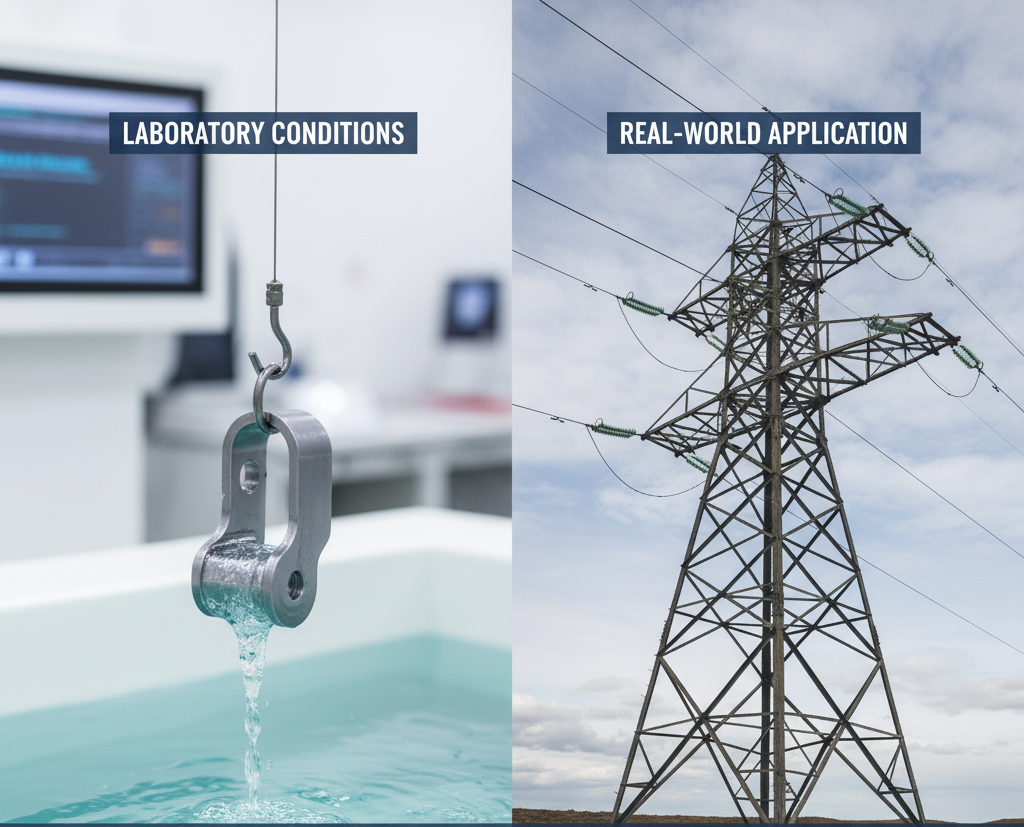
Zinc-nickel value advantages:
- Long-term Protection: Withstands 2000+ hours salt spray testing after chromate conversion
- Self-healing Properties: Minor scratches "heal" through zinc’s sacrificial protection
- Reasonable Cost: Positioned between low-cost trivalent chromate and premium hard chrome
- Low Maintenance: Virtually maintenance-free during protection period
- Wide Applicability: Suitable for carbon steel, alloy steel, and various substrates
Zinc-nickel plating proves particularly valuable for construction structures, transmission towers, automotive components, and outdoor infrastructure requiring medium-to-long term service with difficult maintenance access.
Trivalent Chromate: Smart Choice for Economical Protection
Trivalent chromate conversion coating provides moderate corrosion protection at the lowest cost, representing the most cost-effective choice for indoor applications and mild environments, with its unique pseudo-self-healing capability further enhancing value when minor damage occurs. Compared to traditional hexavalent chromate, trivalent chromate is more environmentally friendly with comparable cost and performance.
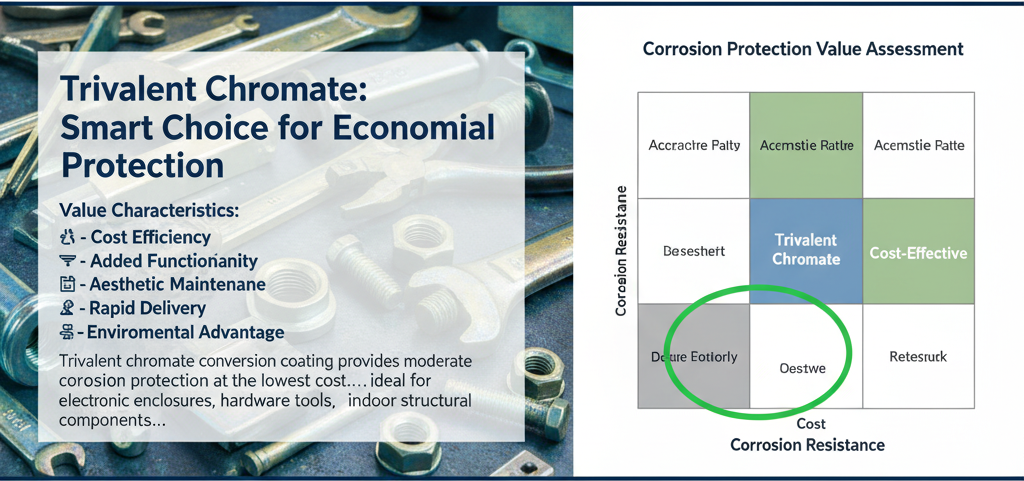
Trivalent chromate value characteristics:
- Cost Efficiency: Lowest initial cost among surface finishes
- Added Functionality: Pseudo-self-healing capability for minor scratches extends effective protection
- Aesthetic Maintenance: Fingerprint resistance maintains product appearance
- Rapid Delivery: Short processing cycles reduce production lead times
- Environmental Advantage: More eco-friendly than traditional hexavalent chromate
Trivalent chromate proves ideal for electronic enclosures, hardware tools, indoor structural components, and short-term outdoor products where cost sensitivity outweighs need for extreme protection.
Electroless Nickel: Value Selection for Multi-functional Protection
Electroless nickel plating delivers excellent corrosion protection and superior wear resistance at moderate cost, providing outstanding value in applications requiring comprehensive performance, with uniform coating distribution particularly beneficial for complex-shaped components. Electroless nickel’s value extends beyond corrosion protection to include additional functional characteristics.
Electroless nickel’s multi-faceted value:
- Uniform Coverage: Maintains consistent thickness even on complex geometries
- High Hardness: Excellent scratch resistance reduces protection failure from wear
- Corrosion Resistance: Superior protection suitable for demanding environments
- Functional Benefits: High impedance suitable for electronic components
- Appearance Quality: Silver-white luster with smooth surface offers decorative appeal
Electroless nickel proves particularly valuable for valve components, hydraulic elements, electronic connectors, and complex mechanical parts requiring both corrosion protection and wear resistance.
Lifecycle Cost Analysis: Value Assessment Beyond Initial Price
The most cost-effective metal finish should be selected based on complete lifecycle cost evaluation rather than initial processing cost12 alone – including installation, maintenance, replacement, and downtime losses13 to reflect true value. Lifecycle cost analysis often reveals that higher initial cost solutions may prove more economical over the long term.
Lifecycle cost components:
- Initial Processing Cost: Direct cost of the surface treatment
- Installation Costs: Pre- and post-treatment preparation and installation expenses
- Maintenance Costs: Regular inspection, cleaning, and upkeep expenses
- Repair/Replacement Costs: Localized repair or complete replacement costs
- Downtime Losses: Production interruption losses from maintenance or replacement
For example, while zinc-nickel’s initial cost exceeds trivalent chromate, its maintenance-free characteristics in outdoor structural applications may reduce 20-year total lifecycle costs by 30-40%.
Application-Driven Selection Strategy
Selecting the most cost-effective corrosion protection1 finish must closely align with specific application requirements, considering component function, design life, aesthetic needs, and maintainability to avoid over-protection or under-protection. Different application scenarios can completely alter value assessments of various finish options.
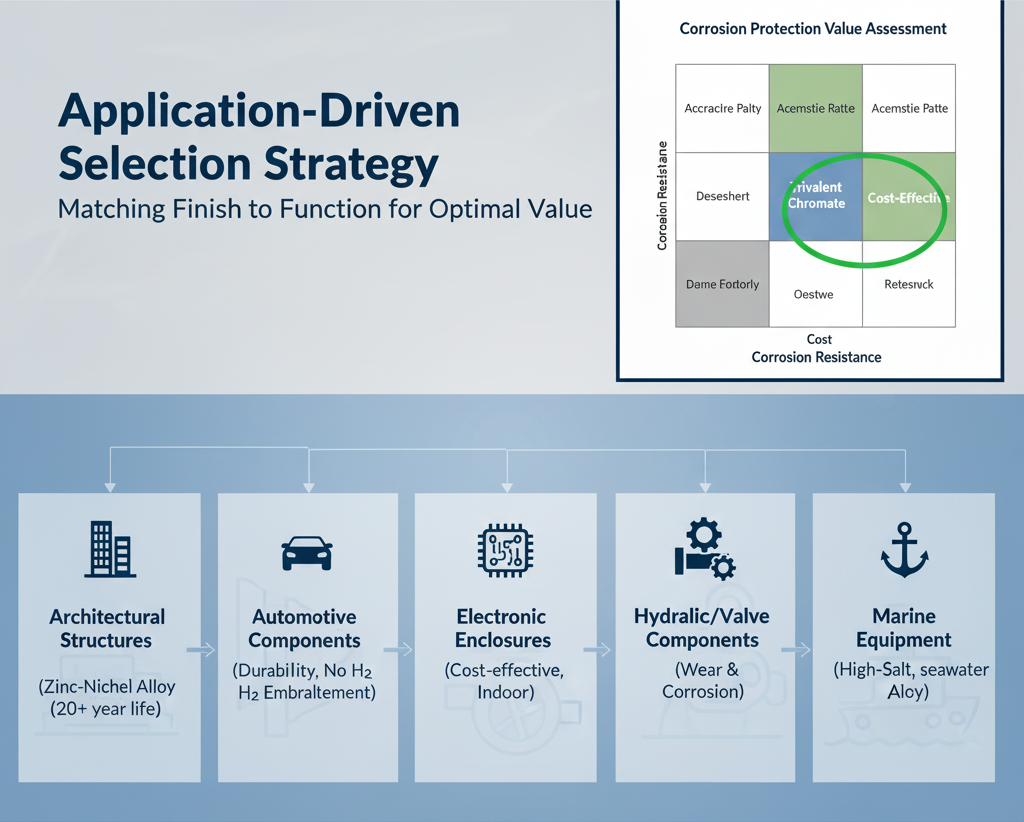
Value selections for different applications:
- Architectural Structures: Hot-dip galvanizing offers best value with 20+ year protection
- Automotive Components: Zinc-nickel alloy balances cost and performance without hydrogen embrittlement
- Electronic Enclosures: Trivalent chromate provides adequate protection with best economics
- Hydraulic/Valve Components: Electroless nickel offers optimal balance of corrosion and wear protection
- Marine Equipment: Zinc-nickel alloy delivers highest value in high-salt environments
Understanding specific application requirements is crucial for selecting the most valuable finish solution, as the same treatment may present completely different value propositions across different applications.
Future Trends: Balancing Environmental and Performance Factors
Metal finish value assessment increasingly incorporates environmental considerations, with trivalent chromate, chrome-free passivation and other eco-friendly processes14 becoming standard choices, meeting sustainability requirements while maintaining performance. Tightening environmental regulations and green manufacturing trends are reshaping traditional surface treatment value equations.
Factors influencing future value:
- Environmental Regulations: Restrictions on hazardous substances driving alternative process development
- Technical Advances: New alloy coatings improving performance while reducing costs
- Circular Economy: Recyclable and reusable characteristics enhancing long-term value
- Energy Efficiency: Low-energy processes reducing lifecycle costs
- Maintenance Innovation: Self-healing technologies minimizing maintenance needs
Future value-leading surface treatments will consider not only economics and performance, but also environmental footprint and sustainability, achieving triple value across economy, performance, and environment.
Conclusion: Rational Selection Through Comprehensive Value Assessment
No universal answer exists for the most cost-effective corrosion protection solution – rather, it’s the optimal balance based on specific requirements, where zinc-nickel plating and trivalent chromate provide the best cost-benefit ratio for most industrial applications, while electroless nickel excels where comprehensive performance is needed. Rational selection requires moving beyond simple price comparisons to comprehensive lifecycle value assessment15.
Key steps for optimal value decision-making:
- Clearly define operating environment and expected service life
- Evaluate different finishes’ initial costs and expected service life
- Estimate potential maintenance, repair, and replacement costs
- Consider additional factors like aesthetics, environmental compliance, regulations
- Calculate total lifecycle cost rather than just initial investment
Through systematic evaluation, you can identify truly cost-effective corrosion protection solutions suited to your needs, achieving the optimal balance between protective performance and economic investment.
-
Find out the most effective corrosion protection methods tailored for various industrial environments. ↩ ↩
-
Explore the advantages of zinc-nickel plating, known for its long-lasting protection and cost-effectiveness in industrial applications. ↩
-
Learn how to analyze performance data to select the best metal finishes for your needs. ↩
-
Learn how aesthetics play a role in selecting metal finishes for various applications. ↩
-
Learn about trivalent chromate’s cost efficiency and unique properties that make it ideal for indoor applications. ↩
-
Understand why wear resistance is crucial for metal finishes in high-abrasion environments. ↩
-
Understand the mechanism of sacrificial anode protection and its role in enhancing metal durability. ↩ ↩
-
Find out which finishes provide the best protection against salt-spray corrosion in coastal areas. ↩
-
Discover which metal finishes are best suited for environments with chemical exposure. ↩
-
Discover how electroless nickel offers superior wear resistance and corrosion protection for complex components. ↩
-
Explore the advantages of maintenance-free solutions that save time and costs in industrial applications. ↩
-
Understand how to assess initial processing costs to make informed decisions on metal finishes. ↩
-
Discover strategies to minimize downtime losses associated with maintenance and replacement. ↩
-
Learn about the latest eco-friendly metal finishing processes that meet sustainability standards. ↩
-
Explore the steps involved in conducting a comprehensive value assessment for metal finishes. ↩
Hi, how have you been lately?