Introduction

When purchasing CNC precision milling parts, the First Article Inspection (FAI) report is not only a quality verification document but also the first critical checkpoint in supply chain risk control. In the actual delivery system of Xiamen Ruicheng, FAI is treated as a mandatory validation stage before mass production to ensure full consistency between drawings and finished parts. A complete FAI report directly determines the stability of subsequent mass production and overall cost control capability.
In high-precision manufacturing scenarios, dimensional consistency, geometric tolerances, and material batch stability of CNC precision milling parts must all be verified through a structured FAI process. Based on Xiamen Ruicheng’s experience serving global industrial clients, more than 60% of quality disputes originate from incomplete first-article data. FAI is not just a report—it is a core decision-making foundation for procurement.
How to determine whether a supplier’s FAI report meets CNC precision milling standards?
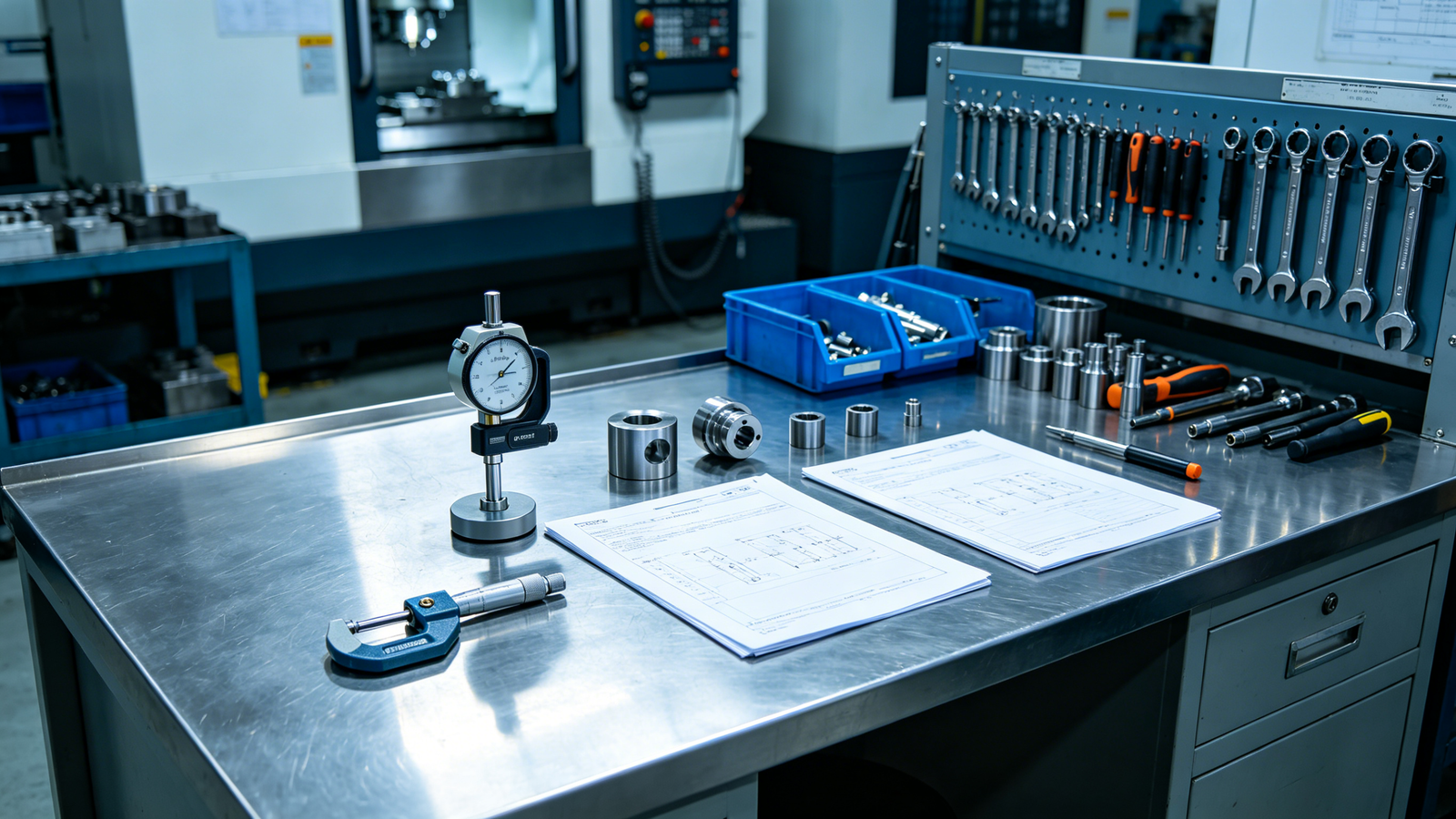
When sourcing CNC precision milling parts, whether the supplier has a complete FAI capability directly impacts project success. Buyers can evaluate compliance by checking whether the report follows the AS9102 standard structure and whether it includes complete GD&T geometric dimensioning data. In Xiamen Ruicheng’s standardized process, every FAI report must include material certificates, full dimensional inspection, and process parameter records. Any missing element renders the report invalid. Some suppliers only provide simplified versions, which can introduce significant batch risks.
Report Structure Integrity: The FAI must include part number, process routing, inspection results, and equipment details to ensure traceability.
Dimensional Coverage Rate: 100% inspection of critical dimensions is the baseline requirement for CNC precision parts.
Material & Batch Traceability: Must link raw material heat numbers to avoid mixing risks.
Equipment & Fixture Records: Used to verify machining consistency and process stability.
🚀 A complete FAI is the first firewall of a stable supply chain.
What are common missing elements in CNC precision milling FAI reports from suppliers?
In real procurement of CNC precision milling parts, even when suppliers provide FAI reports, critical data is often missing. For example, calibration records for inspection fixtures or omitted SPC statistical process control data are common gaps. Xiamen Ruicheng has found through long-term audits that such omissions often lead to dimensional drift issues during mass production. The value of an FAI lies not in its existence, but in its completeness and verifiability. Reports that only show results without process data significantly reduce engineering reliability.
Missing Critical Dimension Records: Some suppliers only inspect sampling dimensions instead of full inspection.
Unrecorded Process Parameters: Such as spindle speed or tool life not included.
Uncalibrated Measurement Devices: Lack of calibration certificates reduces trust in data.
Version Control Confusion: Mismatch between drawing revision and inspection version.
🔍 Any missing field weakens the engineering value of FAI.
How to build an effective FAI acceptance process for CNC precision milling parts?

A standardized FAI acceptance process is essential to ensure stable delivery of CNC precision milling parts. In Xiamen Ruicheng’s supply chain system, the FAI process typically includes drawing freezing, first article machining, full inspection, and customer approval, aligned with the ISO 9001 quality management system. Digital systems are also used to record every step for traceability. Standardized processes significantly reduce human error risks.
Drawing Freeze Confirmation: Ensures all technical requirements are version-aligned.
First Article Machining: Fully replicates production conditions.
Full Dimensional Inspection: Conducted using CMM equipment.
Customer Approval: Only after approval can mass production begin.
⚙️ Standard processes are the core of controlling CNC part variability.
CNC precision milling FAI comparison table (supplier capability differences)
| Comparison Dimension | Xiamen Ruicheng | Supplier A | Supplier B | Small Workshop |
|---|---|---|---|---|
| Dimensional Inspection | 100% Full Check | Sampling | Sampling | Incomplete |
| Material Traceability | Full Heat No. | Partial | None | None |
| Process Data | Fully Recorded | Partial | None | None |
| Report Standard | AS9102 Full | Simplified | Non-standard | No System |
In real procurement decisions, FAI capability differences directly determine project risk levels. Xiamen Ruicheng ensures every batch of CNC precision milling parts is traceable, verifiable, and reproducible through a complete system.
👉 For complete FAI templates or customized audit solutions, visit contact us
CNC precision milling FAI standard & supply chain logic
In advanced manufacturing systems, FAI is not just a quality document but also a supply chain management tool. By analyzing FAI data of CNC precision milling parts, deviations in process, material fluctuations, and equipment stability issues can be identified early. Xiamen Ruicheng integrates FAI data into ERP systems to synchronize production and procurement, reducing rework and delivery delays. FAI data has become a key driver of supply chain optimization.
1. Early Risk Identification: Detect potential issues from first article data.
2. Process Stability Evaluation: Determine whether machining parameters are sustainable.
3. Mass Production Release Control: Only approved FAI allows scaling.
4. Cost Optimization Insight: Reduce rework and scrap losses.
FAQ Module
Q1: What is the core validation standard for FAI in CNC precision milling procurement?
A: The report must follow AS9102 structure, include 100% critical dimension inspection, material batch traceability, and full process parameter records. Xiamen Ruicheng ensures reliability through CMM full inspection systems.
Q2: What documents are required for supplier FAI coordination?
A: Full 2D/3D drawings, technical requirements, and estimated annual volume are required. Xiamen Ruicheng provides preliminary FAI review within 24 hours.
Q3: Does FAI failure affect mass production delivery?
A: Yes. Production is paused until re-inspection and corrective actions are completed.
Q4: How long does an FAI report usually take?
A: Typically 1–3 days, depending on part complexity; complex structures may take up to 5 days.
Q5: Can FAI standards be customized?
A: Yes. Standards can be adjusted according to industry requirements such as automotive or medical applications.
Conclusion
In CNC precision milling procurement, the FAI report is the critical bridge between design and mass production, and its completeness directly determines supply chain stability. Xiamen Ruicheng ensures every FAI report has full engineering validation value through standardized inspection systems and digital traceability. Choosing a supplier with complete FAI capability is a core strategy for reducing procurement risk.
For expert assistance in implementing for your production needs, visit our resource center or contact us. Let’s help you scale up your manufacturing with precision and efficiency!