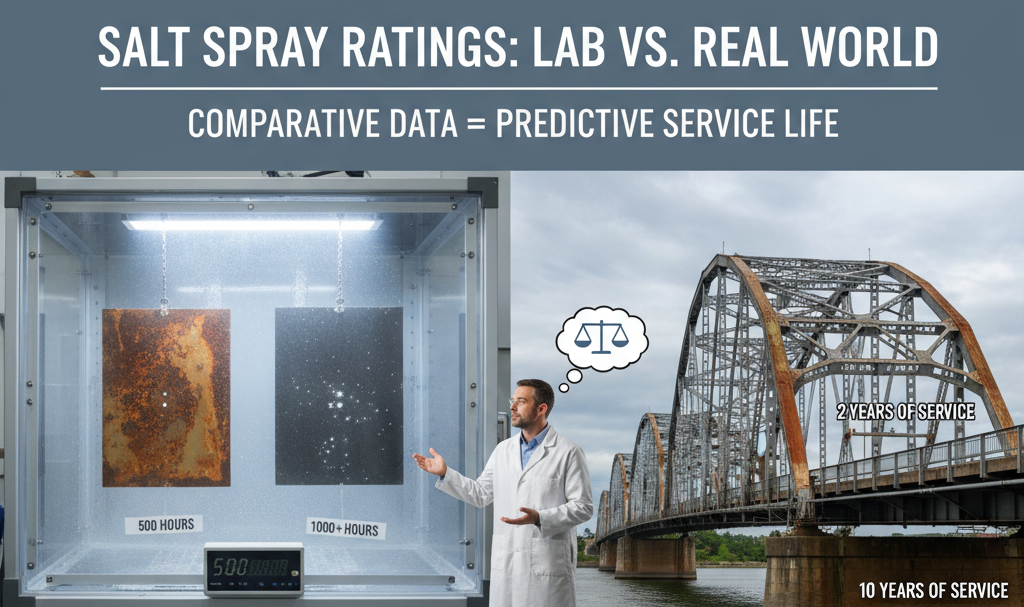
Salt spray ratings provide a standardized measure of a material’s resistance to corrosion in accelerated laboratory conditions1, but their real-world significance is often misunderstood – they primarily offer comparative data rather than precise predictions of actual service life. These ratings, typically expressed in hours until failure or according to standardized scales, represent performance under specific accelerated conditions that don’t directly correlate to years of service in natural environments.
Understanding salt spray ratings requires recognizing their purpose as qualitative comparative tools2 rather than quantitative predictive measurements – they’re most valuable for comparing materials, processes, or suppliers against controls or benchmarks under identical test conditions. The relationship between accelerated test hours and real-world years varies dramatically based on environmental factors, material combinations, and application specifics that standardized tests cannot replicate.
Understanding the Salt Spray Testing Process
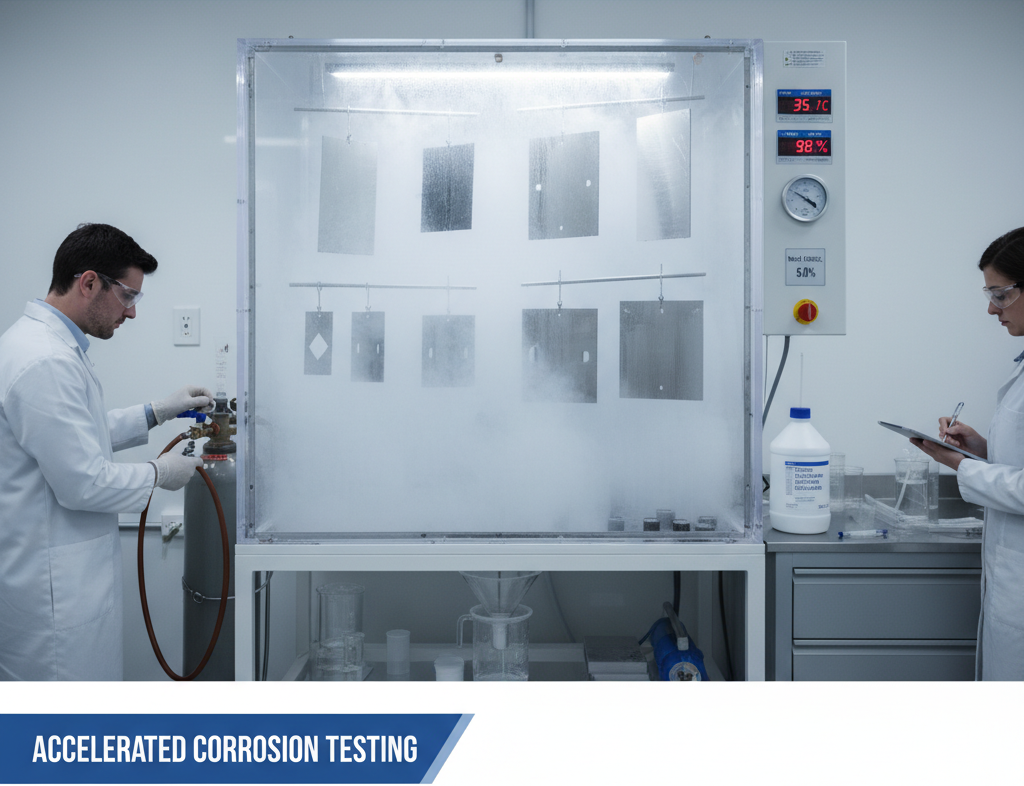
Salt spray testing involves exposing materials to a controlled corrosive environment where a 5% sodium chloride solution3 is atomized into a fog within a sealed chamber maintained at 35°C ± 2°C, creating accelerated corrosion conditions that help evaluate relative corrosion resistance4. This standardized approach allows for reproducible comparisons between materials and finishes when performed according to established protocols.
The test process follows specific procedures including initial sample preparation, controlled exposure in the salt spray chamber, recovery procedures, and final evaluation – with strict controls on solution concentration, pH, temperature, and collection rate to ensure consistent results. Understanding this controlled process highlights why results are comparable between tests but don’t directly translate to real-world performance predictions.
Salt Spray Rating Methods and Classification Systems
Salt spray test results are evaluated using four primary methods: rating classification based on corrosion area percentage5, weight change measurements6, simple pass/fail assessment7 based on corrosion appearance, and statistical analysis of corrosion data – with the 10-level classification system8 being most common for metal finishes. The appropriate evaluation method depends on the material type, application requirements, and industry standards.
The 10-Level Classification System Explained
| Rating Level | Defect Area Percentage | Appearance Description | Practical Significance |
|---|---|---|---|
| 9-10 | 0-0.1% | No changes or minimal discoloration | Excellent corrosion resistance |
| 8 | 0.1-0.25% | Moderate discoloration | Very good performance |
| 7 | 0.25-0.5% | Significant discoloration | Good protection |
| 6 | 0.5-1.0% | Slight corrosion products | Moderate protection |
| 5 | 1.0-2.5% | Initial corrosion signs | Basic protection level |
| 4 | 2.5-5% | Noticeable corrosion | Minimal acceptance |
| 3 | 5-10% | Significant corrosion | Generally unacceptable |
| 2 | 10-25% | Substantial base metal corrosion | Poor performance |
| 1 | 25-50% | Severe corrosion | Failure |
This classification system allows for standardized assessment across different materials and finishes, with most industrial specifications requiring Level 6 or higher for acceptable performance in corrosive environments.
Different industries employ specialized rating approaches tailored to their specific needs – such as the 3-level system for paint coatings that evaluates color change, blistering, and rust formation or automotive industry standards that assess both appearance and functional integrity. These specialized systems address limitations of generic ratings for specific applications and materials.
What Salt Spray Ratings Don’t Tell You
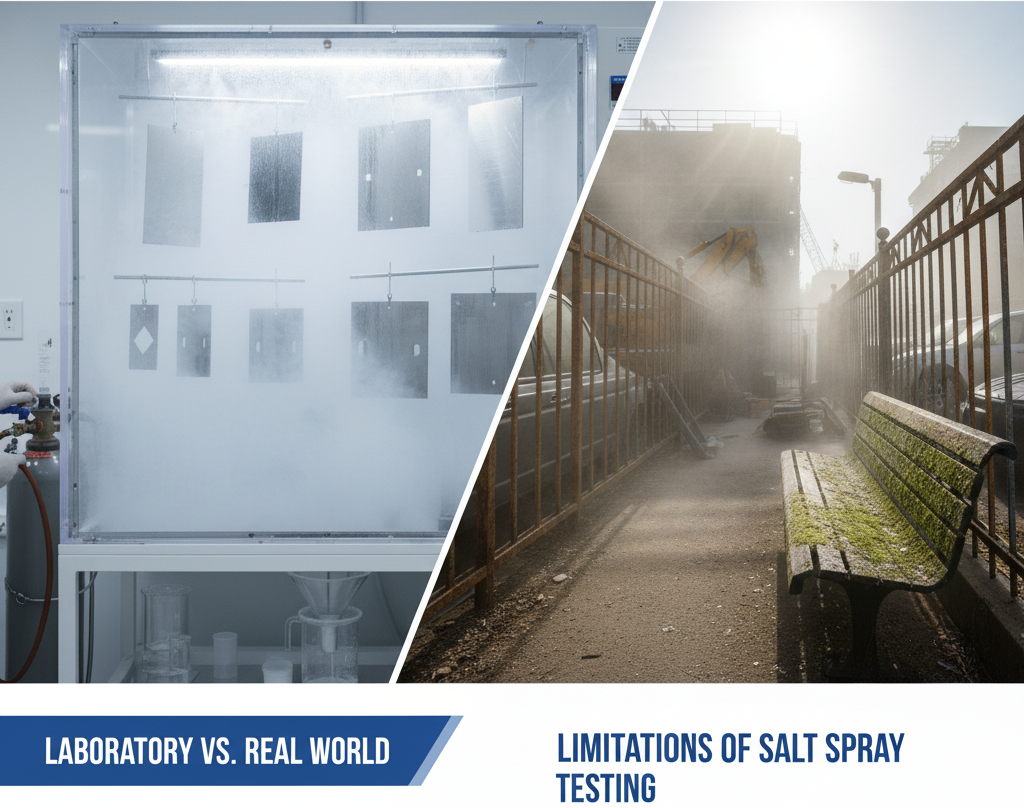
Salt spray ratings9 have significant limitations including poor correlation with actual outdoor performance, inability to replicate real-world environmental cycles, and failure to account for mechanical stresses, UV exposure, and complex environmental factors that affect materials in service. The continuous salt spray environment doesn’t replicate the drying cycles, pollution variations, temperature fluctuations, and mechanical wear that materials experience in real-world applications.
Critical factors absent from standard salt spray testing include UV radiation effects, thermal cycling impacts, mechanical wear and abrasion, complex pollution combinations, and biological influences – all of which significantly affect real-world corrosion behavior in ways that laboratory testing cannot capture. This explains why materials with identical salt spray ratings may perform very differently in actual service environments.
Advanced Corrosion Testing Methods
Cyclic corrosion testing has emerged as a more representative alternative to traditional salt spray testing by incorporating alternating phases of salt spray, humidity, drying, and sometimes UV exposure that better simulate real environmental conditions. These advanced tests provide better correlation with actual service performance, particularly for automotive, aerospace, and architectural applications where materials face varying environmental conditions.
Industry-specific testing protocols10 incorporate salt spray with additional real-world challenges including stone impacts, road salt splashes, and functional assessments that provide more comprehensive corrosion evaluation. These specialized approaches address the limitations of standardized salt spray testing for specific applications.
Interpreting Salt Spray Ratings in Practical Applications
When evaluating salt spray ratings for material selection, consider the specific application environment, required service life, consequences of failure, and actual performance history of similar materials in comparable applications rather than relying solely on laboratory ratings. This contextual approach prevents over-specification for mild environments or under-specification for demanding applications.
Effective salt spray rating interpretation requires understanding that performance varies significantly between material types – with anodized aluminum11, zinc plating, powder coatings, and paint systems each demonstrating different failure modes and protection mechanisms that affect real-world performance. Materials with similar salt spray ratings may fail in completely different ways under actual service conditions.
Industry-Specific Rating Requirements
Different industries maintain specific salt spray rating requirements based on their unique operational environments and performance expectations, with automotive, architectural, and marine applications typically demanding the most stringent corrosion resistance standards. Understanding these industry-specific requirements ensures appropriate material selection for each application.
| Industry | Typical Salt Spray Requirements | Common Standards | Special Considerations |
|---|---|---|---|
| Automotive | 500-1000+ hours | Industry standards | Stone chip resistance, functional integrity |
| Architectural | 300-1000+ hours | Industry standards | Aesthetic appearance, long-term weathering |
| Marine | 1000-5000+ hours | Industry standards | Salt water immersion, high humidity |
| Consumer Electronics | 24-200 hours | Industry standards | Cosmetic appearance, connector function |
| General Industrial | 72-500 hours | Industry standards | Specific environment matching |
These industry standards reflect the varying corrosion challenges and performance expectations across different applications, with more demanding environments requiring higher levels of corrosion resistance.
Implementing Salt Spray Testing in Quality Control
Effective quality control programs use salt spray testing as one component of a comprehensive corrosion evaluation strategy that includes lot sampling, comparative analysis against known standards, and investigation of special causes for both failures and exceptional performances. This systematic approach transforms raw test data into actionable quality intelligence.
Establishing effective salt spray testing protocols10 requires defining appropriate sampling frequency, establishing clear acceptance criteria based on application requirements, maintaining detailed records for trend analysis, and implementing corrective actions when results deviate from standards. This systematic approach ensures consistent product quality and identifies process variations before they affect product performance.
Making Informed Decisions Based on Salt Spray Ratings
Salt spray ratings should inform rather than dictate material selection decisions, serving as one data point within a comprehensive evaluation12 that includes real-world performance13 history, application-specific testing, lifecycle cost analysis, and supplier quality consistency. This balanced approach prevents over-reliance on a single performance metric.
Developing a robust material selection process14 involves using salt spray ratings for initial screening, conducting application-specific testing for finalists, evaluating suppliers based on consistency and technical capability, and establishing ongoing monitoring to verify real-world performance. This comprehensive approach balances laboratory efficiency with real-world relevance.
The Future of Corrosion Testing
Corrosion testing continues evolving toward more realistic assessment methods including integrated cyclic testing, real-time monitoring, combined environmental and mechanical stress application, and digital modeling that better predict actual service performance. These advances address the recognized limitations of traditional salt spray testing.
Industry trends indicate increasing adoption of correlation-based testing15 where accelerated laboratory methods are validated against real-world performance data, creating more reliable predictive models that account for specific environmental factors and application conditions. This approach acknowledges the limitations of standardized testing while leveraging its efficiency benefits.
Conclusion: Putting Salt Spray Ratings in Perspective
Salt spray ratings provide valuable comparative data about corrosion resistance under standardized conditions, but their real meaning emerges only when understood as qualitative indicators within a broader context of material evaluation, application requirements, and real-world performance history. Intelligent use of these ratings requires recognizing both their utility and their limitations.
The most effective approach to material selection combines salt spray ratings with application-specific testing, supplier quality evaluation, field performance monitoring16, and technical understanding of failure mechanisms17 to make decisions that balance performance requirements with economic considerations18. This comprehensive strategy leverages the efficiency of standardized testing while mitigating its limitations through complementary evaluation methods.
Ready to better understand your salt spray test results? Contact our materials testing experts for help interpreting your specific test data and making informed material selection decisions.
Why manufacturers trust our testing expertise:
- Comprehensive corrosion testing experience
- Industry-specific rating interpretation
- Real-world performance correlation
- Supplier quality assessment
- Technical consultation and support
-
Discover how accelerated conditions are created in labs to test material durability and their implications. ↩
-
Understand the role of qualitative tools in comparing materials and their performance under specific conditions. ↩
-
Find out how sodium chloride solution is used to simulate corrosive environments in testing. ↩
-
Learn about the various methods and standards used to measure corrosion resistance in different materials. ↩
-
Explore the methods used to evaluate corrosion area percentage and its significance in testing. ↩
-
Learn how weight change measurements are used to assess material degradation during tests. ↩
-
Discover how pass/fail assessments are conducted and their importance in evaluating material performance. ↩
-
Understand the 10-level classification system and how it helps in assessing corrosion resistance. ↩
-
Explore this resource to understand the significance and application of salt spray ratings in evaluating material corrosion resistance. ↩
-
Discover the established protocols that ensure consistency and reliability in salt spray testing. ↩ ↩
-
Explore the properties of anodized aluminum and its performance in corrosion resistance testing. ↩
-
Learn about the factors considered in a comprehensive evaluation for material selection. ↩
-
Understand the discrepancies between lab results and actual performance in real-world conditions. ↩
-
Discover the steps involved in selecting materials based on corrosion resistance and performance. ↩
-
Understand how correlation-based testing improves the reliability of material performance predictions. ↩
-
Explore the importance of monitoring materials in real-world applications to ensure reliability. ↩
-
Gain insights into the technical aspects of failure mechanisms that affect material performance. ↩
-
Explore how cost factors influence decisions in material selection for corrosion resistance. ↩