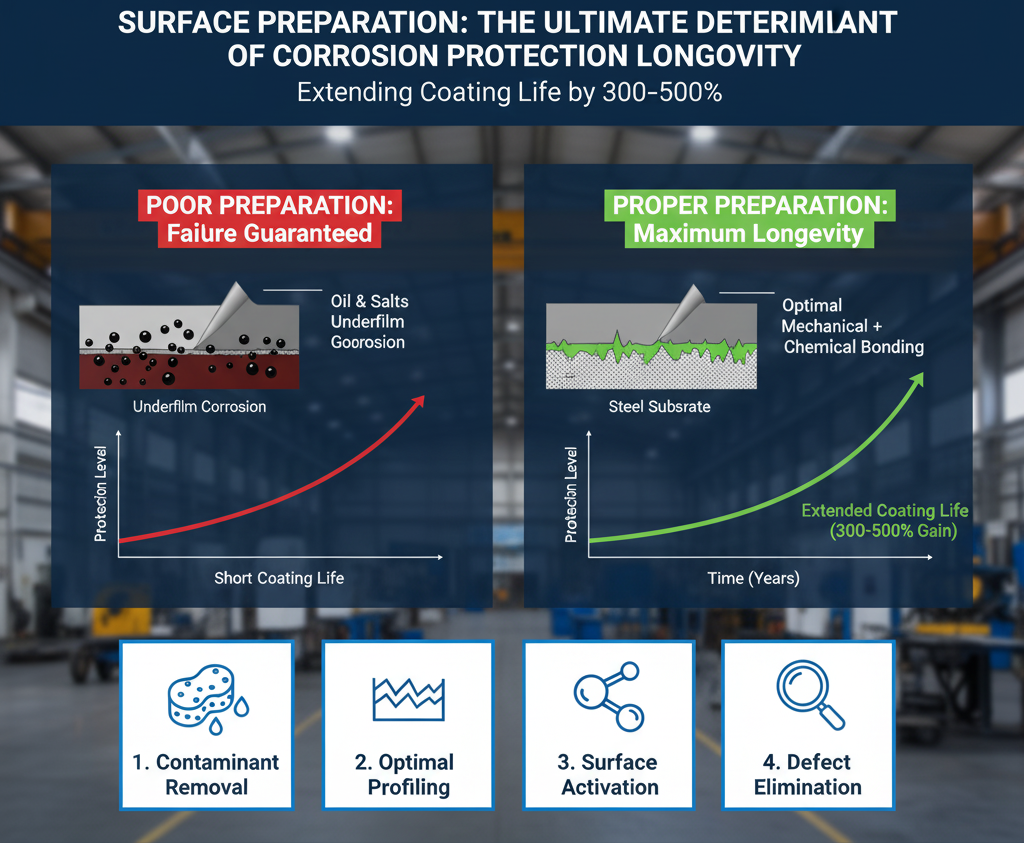
Surface preparation directly determines the effectiveness and longevity of corrosion protection1, with properly prepared surfaces extending coating life by 300-500% compared to poorly prepared substrates in identical environmental conditions. Through decades of corrosion protection experience, we’ve consistently observed that surface preparation quality often matters more than the coating selection itself when it comes to long-term performance in demanding environments.
Proper surface preparation2 creates the essential foundation for corrosion protection through four key mechanisms: complete contaminant removal3 that eliminates hidden corrosion initiators, optimal surface profiling that enables mechanical coating adhesion, surface activation4 that promotes chemical bonding, and defect elimination5 that prevents premature failure points. This comprehensive approach addresses all potential weaknesses in the corrosion protection system before coating application begins.
Why Surface Contamination Guarantees Early Failure
Surface contaminants including oils, salts, rust scale, and environmental residues create micro-environments where corrosion initiates and spreads beneath intact coatings, with even microscopic contamination causing coating disbondment and underfilm corrosion that compromises the entire protection system. These hidden defects become the primary failure points regardless of coating quality or thickness.
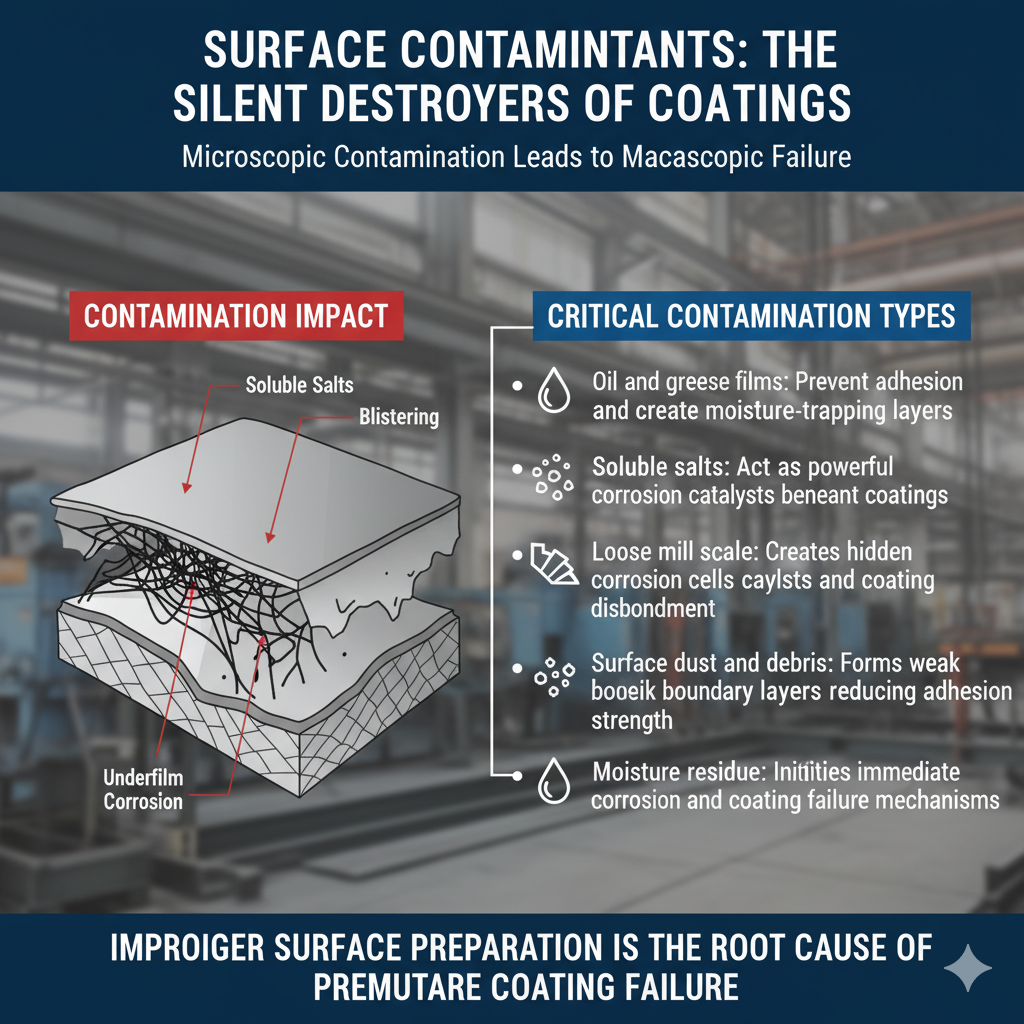
Critical contamination types and their effects:
- Oil and grease films: Prevent adhesion and create moisture-trapping layers
- Soluble salts: Act as powerful corrosion catalysts beneath coatings
- Loose mill scale: Creates hidden corrosion cells and coating disbondment
- Surface dust and debris: Forms weak boundary layers reducing adhesion strength
- Moisture residue: Initiates immediate corrosion and coating failure mechanisms
These contaminants explain why premium coatings consistently fail prematurely when applied to improperly prepared surfaces, regardless of the coating’s inherent corrosion resistance properties.
Surface Profile: The Mechanical Locking Advantage
Optimal surface profiling6 creates microscopic peaks and valleys that dramatically increase surface area and provide essential mechanical interlocking for coatings, with profile depths of 1-4 mils typically increasing coating adhesion strength by 200-400% compared to smooth surfaces. The profile serves as a physical anchor that prevents coating disbondment under environmental stress and thermal cycling7.
Profile requirements by coating type:
- Epoxy coatings: 2-4 mil profile for maximum adhesion and barrier protection
- Zinc-rich primers: 1.5-3 mil profile for optimal cathodic protection
- Polyurethane topcoats: 1-2 mil profile for UV and chemical resistance
- Powder coatings: 1.5-3 mil profile for thermal expansion accommodation
- Metallic coatings: 1-3 mil profile depending on application method
Proper profiling ensures coatings maintain adhesion through thermal cycling7, mechanical impact, and long-term environmental exposure that would cause smooth-surface coatings to fail prematurely.
Surface Cleanliness Standards and Performance Correlation
Industry cleanliness standards8 including SSPC, ISO, and NACE define specific contamination removal requirements that directly correlate with coating performance, with near-white metal blast cleaning typically providing 3-5 times longer coating life compared to commercial blast cleaning in identical environments. Understanding these standards ensures appropriate preparation selection for each application’s requirements.
| Cleanliness Standard | Contamination Remaining | Expected Coating Life | Performance Improvement |
|---|---|---|---|
| SSPC-SP 5 (White Metal) | None visible | 15-25 years | Reference standard |
| SSPC-SP 10 (Near-White) | Minimal shadows | 10-20 years | 200-300% better than SP 7 |
| SSPC-SP 6 (Commercial) | 33% staining allowed | 5-12 years | 100-150% better than SP 7 |
| SSPC-SP 7 (Brush-off) | Most mill scale remains | 2-5 years | Baseline performance |
Selecting the appropriate cleanliness standard based on environment severity and coating requirements ensures optimal corrosion protection without unnecessary preparation costs for less demanding applications.
Preparation Methods and Their Technical Merits
Different surface preparation methods achieve varying levels of cleanliness and profile consistency, with abrasive blasting9 providing the most reliable results for critical applications, while water jetting, power tools, and chemical methods serve specific situations with distinct advantages and limitations. Method selection requires balancing technical requirements with practical constraints.
Preparation method technical comparison:
- Abrasive blasting: Most consistent cleanliness and profile control across large areas
- Water jetting: Superior soluble salt removal and environmental compliance
- Power tool cleaning: Practical for spot repair, welds, and limited access areas
- Chemical cleaning: Excellent for degreasing and specific contamination removal
- Flame cleaning: Effective for moisture removal in specific applications
Each method delivers different cleanliness levels, profile characteristics, and production rates that must align with project requirements and environmental conditions.
Surface Activation and Chemical Pretreatments
Surface activation through chemical treatments or immediate coating application creates molecular-level bonding sites that significantly enhance coating adhesion and corrosion resistance, with properly activated surfaces showing 50-100% better performance than inert surfaces in accelerated testing. Activation prevents the surface degradation that occurs between preparation and coating application.
Activation methods and technical benefits:
- Chemical conversion coatings: Create corrosion-resistant surfaces and enhance adhesion
- Surface passivation: Forms protective oxide layers on stainless steel and aluminum
- Immediate coating application: Prevents surface recontamination and oxidation
- Reactive primers: Provide specialized bonding and corrosion inhibition
- Surface energy modification: Improves coating wetting and penetration
Proper activation ensures the prepared surface maintains its optimal condition until the protective coating is applied, preserving the preparation investment and maximizing performance.
Environmental Control During Preparation
Environmental conditions during surface preparation significantly impact results, with humidity, temperature, and surface moisture affecting abrasive performance, coating adhesion, and the likelihood of immediate flash rusting that compromises long-term corrosion protection. Controlling preparation environment is as critical as the preparation method selection itself.
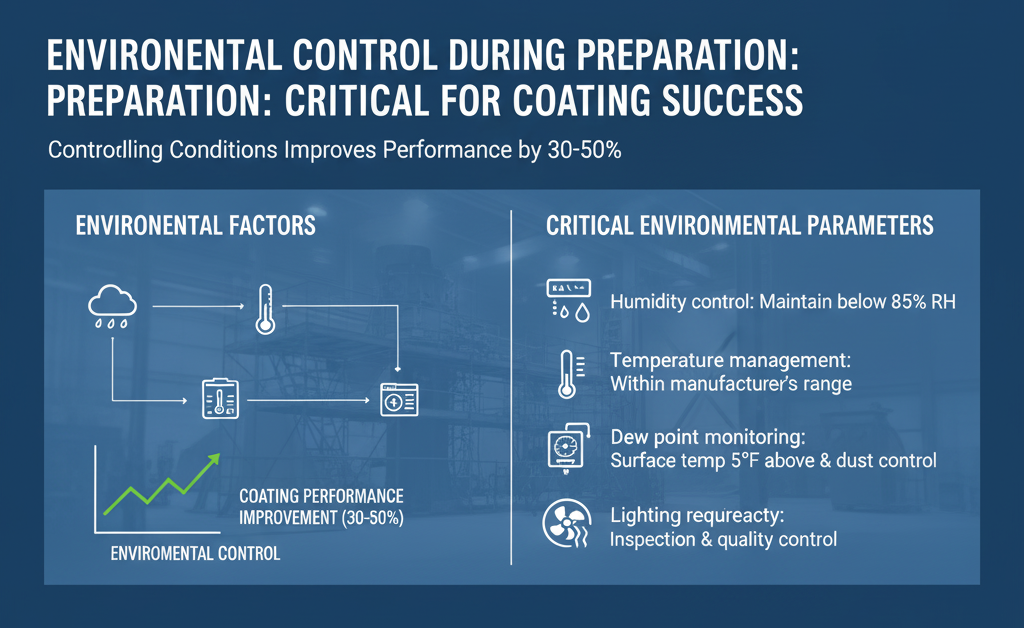
Critical environmental parameters:
- Humidity control: Maintain below 85% RH to prevent flash rust and moisture contamination
- Temperature management: Within coating manufacturer’s specified application ranges
- Dew point monitoring: Surface temperature 5°F above dew point minimum requirement
- Ventilation requirements: Proper fume and dust control for worker safety and contamination prevention
- Lighting adequacy: Sufficient illumination for proper inspection and quality control10
Environmental control during preparation typically improves coating performance by 30-50% compared to unprepared conditions in variable environments, representing one of the most cost-effective quality improvements available.
Quality Verification and Performance Assurance
Comprehensive quality control ensures surface preparation meets specifications, with verification methods including visual comparators, soluble salt testing, surface profile measurement, and adhesion testing11 that directly correlate with long-term corrosion performance. Proper verification prevents costly rework after coating application and ensures performance expectations are met.
Quality verification techniques and standards:
- Visual standards: SSPC-VIS and ISO 8501 comparators for cleanliness assessment
- Soluble salt testing: Bresle method and conductivity measurement for contamination detection
- Profile measurement: Replica tape, laser profilometry, and testex press-o-film methods
- Adhesion testing: Pull-off adhesion measurement for performance prediction
- Documentation systems: Comprehensive records for traceability and performance analysis
Implementing rigorous quality control typically identifies 15-25% of surfaces requiring additional preparation before coating application, preventing premature failures and ensuring consistent performance across projects.
Economic Analysis of Preparation Investment
While surface preparation represents 40-60% of total coating system cost, proper preparation typically provides 300-500% return on investment through extended coating life, reduced maintenance frequency, and prevention of catastrophic corrosion failures. The economic benefits consistently outweigh the initial preparation costs across all application types.
Lifecycle cost considerations:
- Initial cost allocation: Surface preparation typically 40-60% of total coating cost
- Service life extension: 3-5x longer service life with proper preparation standards
- Maintenance reduction: Significantly lower recoating and repair frequency and costs
- Failure prevention: Avoids costly structural damage and production losses
- Warranty compliance: Meets manufacturer requirements for performance guarantees
The economic analysis12 clearly demonstrates that investing in proper surface preparation provides exceptional value through dramatically improved corrosion protection performance and reduced total lifecycle costs.
Ready to Optimize Your Surface Preparation Process?
Our surface preparation expertise ensures your corrosion protection systems achieve their maximum potential, with processes tailored to your specific substrates, environmental conditions, and performance requirements. Contact us for a comprehensive preparation assessment and technical recommendation.
Why manufacturers trust our preparation expertise:
- Comprehensive surface preparation capabilities and experience
- Industry standard compliance and certification
- Quality verification and documentation systems
- Environmental adaptation and control expertise
- Lifecycle cost optimization and validation
Don’t let inadequate surface preparation undermine your corrosion protection investment – partner with experts who understand how to create the perfect foundation for long-term durability and performance.
-
Explore effective strategies to enhance corrosion protection and ensure long-lasting results. ↩
-
Learn how proper surface preparation can significantly improve coating adhesion and longevity. ↩
-
Discover techniques for effective contaminant removal to enhance coating performance. ↩
-
Discover how surface activation enhances coating adhesion and corrosion resistance. ↩
-
Find out how to eliminate defects that can compromise coating integrity. ↩
-
Understand how surface profiling increases adhesion strength and prevents coating failure. ↩
-
Understand the impact of thermal cycling on coating performance and longevity. ↩ ↩
-
Get insights into cleanliness standards that ensure optimal coating performance. ↩
-
Find out why abrasive blasting is a preferred method for achieving consistent cleanliness. ↩
-
Discover quality control methods that ensure effective surface preparation and coating success. ↩
-
Explore various adhesion testing methods to predict coating performance. ↩
-
Learn how proper surface preparation can lead to significant cost savings over time. ↩